> For the complete documentation index, see [llms.txt](https://docs.voiceb.ai/llms.txt). Markdown versions of documentation pages are available by appending `.md` to page URLs; this page is available as [Markdown](https://docs.voiceb.ai/blog/inbound-sales-is-being-replaced-not-optimized.md).
# Inbound Sales Is Being Replaced — Not Optimized
By Alex Bisbe. January, 20th 2026.
Let’s be clear: **inbound sales as we know it is ending**.\
Not because companies want change—but because **the economics no longer work**.
For two decades, enterprises have tried to *optimize* inbound sales:
* Better IVRs
* Better scripts
* Better training
* Better dashboards
None of it fixed the core problem.
**Humans don’t scale. Software does.**
What’s happening now isn’t incremental improvement. It’s **replacement**.
***
### The uncomfortable truth about inbound sales
Inbound sales sits at the intersection of three structural failures:
1. **Cost inflation**
* Hiring, training, attrition
* Idle time, peak-hour overload
* Variable quality per agent
2. **Experience degradation**
* Long wait times
* Repeated questions
* Inconsistent answers
3. **Conversion ceilings**
* Scripts are forgotten
* Objections are mishandled
* Follow-ups are missed
Enterprises have accepted this as “normal”.
It isn’t.\
It’s a legacy constraint.
***
### Why IVRs, Chatbots, and AI Voice Fell Short
The market didn’t fail to *try*.\
It failed by optimizing the wrong layer.
#### IVRs — Cost Deflection Engines
* Built to **avoid calls**, not close sales
* Rigid decision trees in a **probabilistic buying journey**
* Success measured in **cost reduction**, not revenue impact
**Result:** Friction, abandonment, zero persuasion.
***
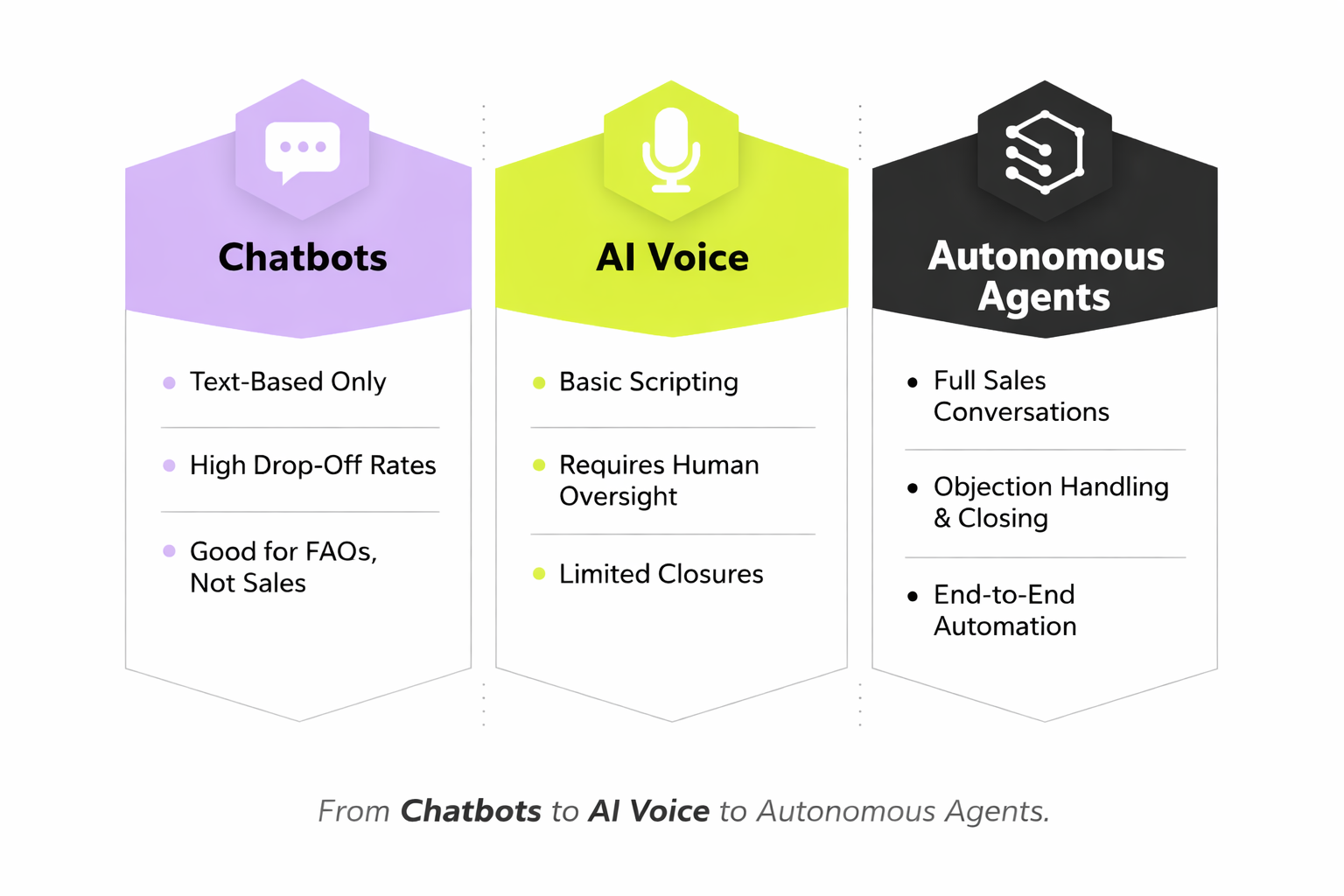
#### Chatbots — Text in a Voice Moment
* Text-first in moments where **users want to speak**
* High drop-off, especially on mobile
* Effective for FAQs, **irrelevant for sales conversations**
**Result:** Engagement without conversion.
***
#### AI Voice / Copilots — Assistance, Not Autonomy
* Depend on humans to execute the sale
* Scale limited by agent availability
* Outcomes vary with training, fatigue, and context
**Result:** Better agents, same bottleneck.
***
#### The Core Problem
All of these approaches **optimize humans**.\
None of them **replace the sales function**.
That’s the line Autonomous Agents cross.
***
### The inflection point: AI that can sell
The breakthrough isn’t “AI that talks”.
It’s AI that can:
* Pitch
* Handle objections
* Qualify intent
* Collect structured data
* Route or close autonomously
* Learn from every interaction
This is not conversational UI.\
This is **sales execution**.
Voice + LLMs + real-time decisioning = **Autonomous Inbound Sales**.
***
### The autonomy spectrum (L0 → L4)
Inbound sales doesn’t flip overnight.\
It transitions through **levels of autonomy**.
#### L0 — Fully Human
* Traditional call center
* High cost, low scalability
* Zero leverage
#### L1 — AI Qualification
* AI answers, qualifies, routes
* Humans still sell
* Cost reduction begins
#### L2 — AI Pre-Sales
* AI pitches and handles first objections
* Humans close
* Conversion improves
#### L3 — Assisted Autonomous Sales
* AI sells end-to-end
* Humans handle edge cases only
* This is where economics flip
#### L4 — Fully Autonomous Sales
* AI handles 100% of inbound
* Humans manage strategy, not calls
* Call centers disappear
Most enterprises are already moving—whether they admit it or not.
***
### Why this time is different
Three things changed simultaneously:
1. **LLMs understand intent**, not keywords
2. **Voice synthesis is human-grade**, not robotic
3. **Inference costs collapsed**, enabling scale
This stack didn’t exist 24 months ago.
Now it does.
***
### What happens to humans?
They don’t disappear.\
They **move up the value chain**.
Humans become:
* Exception handlers
* Deal doctors
* Relationship owners
* Strategy and optimization layers
What disappears is **human-as-a-router**.
That role is economically obsolete.
***
### The enterprise reality check
Enterprises don’t adopt Autonomous Sales because it’s cool.\
They adopt it because:
* Inbound demand keeps growing
* CAC keeps rising
* Hiring does not scale
* Boards demand margin
Autonomy is not a vision.\
It’s a **forced move**.
***
### Where VoiceB.ai fits
VoiceB was built on one premise:
> *Inbound sales should be autonomous by default.*
Not assisted.\
Not augmented.\
**Autonomous.**
That means:
* AI that sells, not just answers
* Clear autonomy levels, not vague promises
* Enterprise-grade data control and compliance
* Measurable outcomes: conversion, cost, revenue
We don’t replace agents.\
We replace **the need for agents** in inbound.
***
### The bottom line
Inbound sales will not be optimized into the future.\
It will be **replaced by software**.
The only open question is:
* Who moves first
* And who keeps paying for legacy cost structures
Autonomous Inbound Sales isn’t coming.
It’s already happening.
---
# Agent Instructions
This documentation is published with GitBook. GitBook is the documentation platform designed so that both humans and AI agents can read, navigate, and reason over technical content effectively. Learn more at gitbook.com.
## Querying This Documentation
If you need additional information that is not directly available in this page, you can query the documentation dynamically by asking a question.
Perform an HTTP GET request on the following URL with the `ask` and `goal` query parameters:
```
GET https://docs.voiceb.ai/blog/inbound-sales-is-being-replaced-not-optimized.md?ask=&goal=
```
`ask` is the immediate question: it should be specific, self-contained, and written in natural language.
`goal` is what the user is ultimately trying to achieve, the reason they need the answer. Sharing it helps GitBook give you a better, more relevant answer. A goal is most helpful when it describes the outcome the user wants rather than restating the question. For example, with `ask=how do I create an API token`, a goal like `build a script that syncs our docs to a CMS` lets GitBook tailor the answer to that use case.
The response will contain a direct answer to the question and relevant excerpts and sources from the documentation.
Use this mechanism when the answer is not explicitly present in the current page, you need clarification or additional context, or you want to retrieve related documentation sections.